Bitcoin (BTC) fell to its lowest level since September 18 following a security breach—involving a loss of $6.3 billion—at Binance, the world’s largest cryptocurrency exchange. The attack has been attributed to North Korean hackers.
The leading cryptocurrency dropped to an overnight low of $76,400 before staging a partial recovery. Ethereum (ETH) briefly touched $2,170 before rebounding to approximately $2,220.
Approximately $3 billion in funds have been frozen, and the exchange has currently suspended withdrawals. Analytics firms TRM Labs and Elliptic have linked the hack to hacker groups associated with North Korea.
Tech stocks added to the downward pressure, with Nasdaq 100 futures falling 2.3% after Amazon (AMZN) raised its capital expenditure forecast. Meanwhile, shares of Intel (INTC) plunged by about 25% following weak guidance.
According to Farside Investors, U.S. spot Bitcoin ETFs saw an inflow of $17 million on Thursday—prior to the theft—marking the fourth consecutive day of net inflows.
Derivatives Positioning
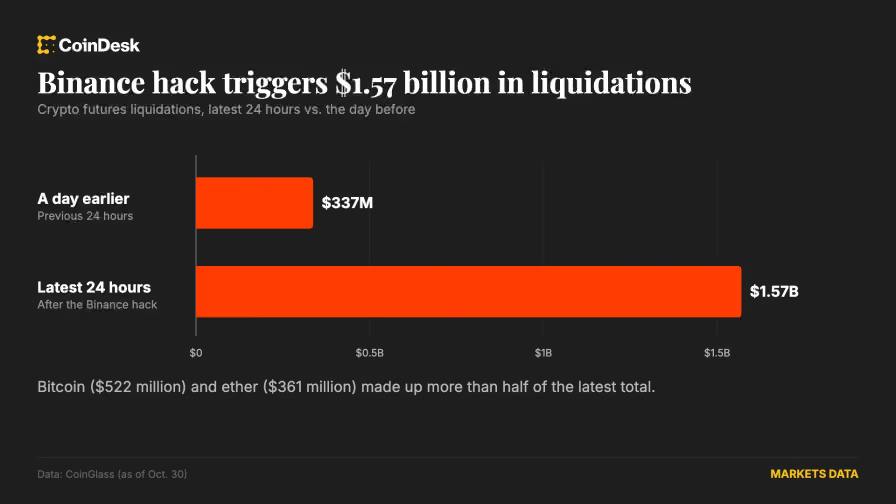
Surge in Liquidations: As the Binance hack impacted prices, crypto futures liquidations quadrupled, reaching $1.57 billion. Trading volume climbed 74% to $346.1 billion, while open interest (OI) fell 3% to $136.3 billion, indicating that traders were closing positions and capital was exiting the futures market. The taker buy/sell ratio suggests a slight edge for sellers, following a neutral stance the previous day.
Bitcoin Holds Steady, Ethereum Pulls Back: BTC fell 3.1% over 24 hours, while its open interest declined by only 1.4%, suggesting that some capital remained in the market despite the downturn. ETH dropped 4%, with a 5.8% decline in open interest, signaling a modest outflow of capital. The BTC funding rate is positive and rising, indicating that long positions are paying short positions, and perpetual contract traders remain biased toward the long side. The ETH funding rate is positive but has declined, suggesting that this bullish bias is weakening. BTC and ETH account for more than half of the total liquidation volume, reaching $522 million and $361 million, respectively.
Capital outflows from SOL and NEAR: Open interest in SOL has decreased by 13.3% alongside a 3.3% drop in price, signaling an outflow of capital from SOL futures. While the price of NEAR has remained relatively stable, its open interest has fallen by 11.8%—marking the second consecutive day of capital outflows. For both assets, funding rates have shifted from positive to negative, meaning short positions are now paying long positions; additionally, the Cumulative Volume Delta (CVD) for both is negative, indicating that sell orders are dominating the market.
BNB open interest remains stable: BNB fell by 6.2%—the largest decline among major cryptocurrencies—even though its open interest (in USD terms) remained flat. Trading volume for the asset more than tripled. The funding rate is negative, meaning short positions are paying long positions, and the negative Cumulative Volume Delta (CVD) points to a market dominated by sell orders.
HYPE bucks the trend: HYPE rose by 15%, accompanied by a 28% surge in open interest, reflecting an influx of capital while the rest of the market declined. Trading volume spiked nearly eightfold. The funding rate is positive and rising, indicating higher costs for holding long positions, while a positive Cumulative Volume Delta (CVD) suggests that buy orders are dominating the market.
Mixed trends in funding rates: For most cryptocurrencies, funding rates remain positive, meaning long positions are paying short positions. However, the number of assets with negative funding rates has grown—now including BNB, SOL, NEAR, and TRX—meaning that for these contracts, short positions are paying long positions. Among these, TRX recorded the most negative funding rate overnight. Monero (XMR) has the highest funding rate, followed by HYPE.
CVD Decline: With the exception of TRX, HYPE, ZEC, XMR, and BCH, the 24-hour Cumulative Volume Delta (CVD) for open interest is negative across all major coins. This indicates that, for the broader market, sell orders have outweighed buy orders relative to open interest.
Defensive Options Flow: Five of the six most actively traded Bitcoin options are puts, all with strike prices below the current market price. The $74,000 strike put option expiring on November 13 leads in trading volume. For Ethereum, the bias toward puts is even more pronounced; the $2,000 strike put option expiring on November 13 has more than double the volume of any other Ethereum option, with only one call option appearing among the top six.
Strengthening Bearish Sentiment: The 25-delta skew—which measures the premium of puts relative to calls—has risen across all timeframes for both BTC and ETH, signaling an increased demand for protective positions. The hack of the Binance exchange has further fueled demand for put options, causing a sharp spike in the 30-day implied volatility index within the Asian market, though some of those gains have since been erased.
Token Discussion
Tokens held and subsequently sold by the Binance exchange hacker have led a rebound: Ethena (ENA) rose 8.4%, Pepe (PEPE) climbed 7.3%, Uniswap (UNI) gained 4.6%, and Chainlink (LINK) increased by 3.7%. According to data from Lookonchain, Uniswap and Aave both saw declines of approximately 11% on Thursday as the attacker swapped their holdings for Ether.
Aave (AAVE) and Arbitrum (ARB) both rose by about 4.5%. This follows Aave’s decision to freeze its lending markets across 16 networks after an attacker used stolen USDT as collateral to borrow approximately $44.6 million worth of Ether. Thorchain (RUNE) rose by 6.2%, while Elliptic and on-chain analyst ZachXBT tracked a portion of the stolen funds as they moved to the Ethereum network via a cross-chain protocol.
LayerZero (ZRO) climbed 12%—the largest gain among the CoinDesk 100—whereas Curve (CRV) fell 7.2% and Tron (TRX) dropped 4.9%.
CoinMarketCap’s “Altcoin Season” index declined from 54 on Thursday to 45 out of 100, and its “Fear & Greed” index slipped from 43 to 36 out of 100, signaling a state of “fear.”