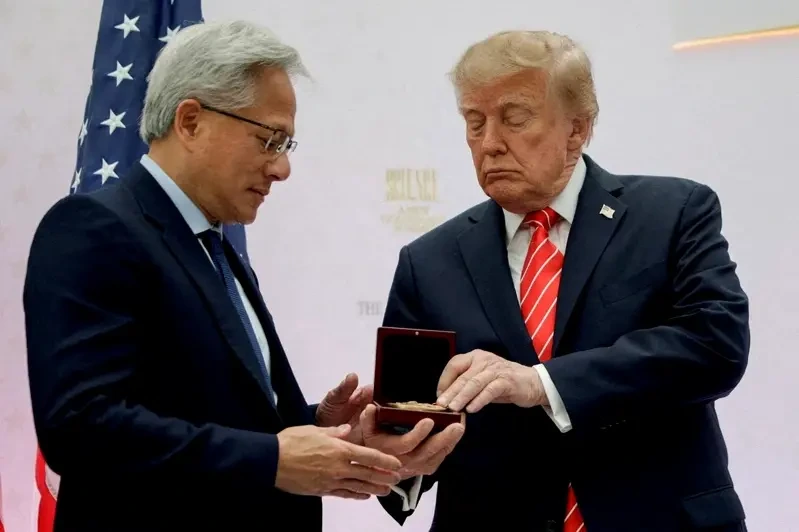
Trump is betting on AI and NVIDIA to boost the U.S. economy; however, the public, Congress, and investors remain deeply skeptical regarding the potential impact on jobs, national security risks, and the likelihood of seeing a return on massive AI investments.
Trump is banking on AI to drive the American economy—even urging Jensen Huang to take the helm at NVIDIA—yet he has struggled to convince voters and investors. The Wall Street Journal reports that the public fears job displacement, while lawmakers from both parties are preparing to scrutinize national security concerns and the ties between politics and business. Meanwhile, Bloomberg notes that although government intervention provided a temporary boost to the stock market, it has failed to resolve market doubts about whether the enormous investments in AI will ever pay off.
The Wall Street Journal points out that Trump is increasingly pinning the legacy of a potential second term on a single conviction: that what is good for AI companies is also good for the United States. Persuading the American public of this, however, has become a significant political challenge.
The White House maintains that preserving U.S. leadership in artificial intelligence (AI) will drive revenue, innovation, and productivity growth. Trump has also emphasized that the construction of new facilities and data centers creates jobs, while threatening heavy penalties against companies that choose to build data centers overseas.
However, the public may not be convinced. Citing a national survey of midterm election voters conducted by SSRS, The Wall Street Journal reported that 57% of respondents believe AI does more harm than good to society, while only about a quarter believe the benefits outweigh the drawbacks. Furthermore, three-quarters of respondents oppose the construction of new data centers in their own communities.
Scott Lincicome, a vice president at the Cato Institute, told The Wall Street Journal that Trump has failed to adequately explain how this technology benefits the U.S. economy or national security. Consequently, it is difficult to persuade the public that bringing Jensen Huang back into the fold serves the interests of ordinary citizens.
“Right or wrong, the perception is that the president cares more about billionaires than he does about the average person,” Lincicome said.
Republican strategist Douglas Heye also noted that because Trump has failed to convince the public that they stand to benefit from AI, his efforts to assist Nvidia are easily interpreted as cronyism—favoring his own associates.
Congress Prepares to Probe Stock Holdings, Donations, and Chip Exports
The Wall Street Journal reports that setbacks in the midterm elections have weakened Donald Trump’s political standing, emboldening Republican lawmakers to scrutinize whether his private financial interests have become intertwined with government policy.
According to reports, Trump held shares in Nvidia that were valued at $83 million in October. Furthermore, at the request of Nvidia CEO Jensen Huang, Trump authorized the sale of Nvidia chips to mainland China and other nations raising national security concerns. In turn, Nvidia pledged $25 million toward renovations for the White House State Dining Room and contributed $1 million to Trump’s second inauguration.
White House spokesperson Davis Ingle stated that Trump’s stock and bond investments are managed by independent financial institutions. He emphasized that neither Trump nor his family members have the authority to direct, influence, or participate in investment decisions, nor do they determine the timing of any buy or sell transactions.
Members of Congress are preparing to investigate whether the government and Nvidia circumvented U.S. regulations designed to prevent mainland China from acquiring advanced chips, as well as the reasons behind Trump’s intervention in personnel matters. Jensen Huang is scheduled to undergo closed-door questioning by three House committees on December 1, followed by public testimony before the Senate Banking Committee on December 3.
Some conservative commentators have also warned that the convergence of conflict-of-interest allegations, national security policy regarding China, and public anxiety surrounding AI could create a political challenge that the Republican Party may struggle to handle.
Jensen Huang Saved, Yet Market Questions Remain Unresolved
According to a Bloomberg report, Donald Trump’s intervention not only restored the most prominent advocate for AI to the helm but also brought back a key financial catalyst—Jensen Huang—who has been instrumental in driving the company’s recent expansion. However, the enthusiasm surrounding Huang’s return proved short-lived; the initial excitement faded in less than a day, followed by a sell-off in tech stocks. A rebound eventually arrived on Friday, with the S&P 500 index climbing 1.6%.
Steve Sosnick, Chief Strategist at Interactive Brokers, told Bloomberg that this intervention effectively signals that both Nvidia and Jensen Huang are “too big to fail”—implying that maintaining strong ties with those in power can secure a lifeline when needed.
Nevertheless, Bloomberg notes that even with the full backing of the U.S. government, a fundamental question regarding this investment frenzy remains unanswered: Who will actually make a profit in the end? Furthermore, given the massive scale of computing infrastructure currently being built, what will the actual future demand look like? Meanwhile, rising borrowing costs have raised the bar for achieving a return on investment.
Michael Reynolds, Vice President of Investment Strategy at Glenmede, explained that because the market struggles to gauge future demand for computing power, it has become hypersensitive to every piece of new information—prompting investors to constantly recalibrate their outlooks.
Some capital has already shifted toward other sectors. JP Powers, Chief Investment Officer at RWA Wealth Partners—which manages approximately $22 billion in assets—stated that investors are moving away from companies focused exclusively on providing cloud computing power, diversifying instead into the healthcare and consumer staples sectors.
Amidst stock market volatility, the U.S. economy remains robust. According to Bloomberg, the annualized quarter-on-quarter growth rate of Gross Domestic Product (GDP) for the third quarter reached 4.3%, with AI-related investments, household wealth, consumer spending, and government outlays all bolstering economic activity.
However, this presents a double-edged sword for the stock market. A prolonged market downturn could drag down consumer spending; conversely, the current economic heat makes it more difficult for the Federal Reserve to loosen monetary policy. Traders have already fully priced in an interest rate hike for next month, which further increases financing pressures for AI infrastructure development.
Nevertheless, Justin Bergner, a portfolio manager at Gabelli Funds, told Bloomberg that the AI investment boom—which has unsettled Wall Street—is actually propping up the U.S. economy, making it more resilient against a potential recession. Last Friday, he took advantage of a dip in Nvidia shares to a recent low and has been selectively scouting for other tech stocks that have suffered sharp declines.
Bloomberg also noted that recent market turbulence has pushed the net equity exposure of hedge funds down to multi-year lows. Some model-driven funds currently hold substantial short positions, reflecting a high demand for hedging. Consequently, even a slight improvement in sentiment could trigger a wave of short-covering.
For investors, a short-term market rebound does not necessarily require a definitive answer as to who the ultimate winners in the AI race will be. Yet, for Donald Trump, a rising stock market alone is insufficient to address the question of what tangible benefits this AI boom might actually deliver to the average American.